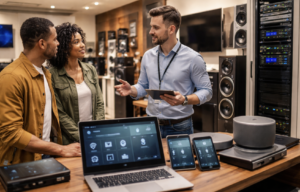
For a long time, home audio was treated like a separate category from information technology. Speakers were speakers, receivers were receivers, and networking belonged to the office or the server room. That line has changed. Modern audio systems now depend on wireless performance, device interoperability, app-based control, cloud connectivity, firmware management, cybersecurity, and ecosystem integration. In practical terms, that means a home audio conversation now overlaps with an IT conversation far more than many businesses realize. A page about Home Audio Stores near Me can make strong sense on an IT website because the modern listening experience is no longer just about sound. It is about how sound fits into a connected environment that has to be fast, stable, secure, and easy to manage.
Modern Home Audio Is Part of the Connected Technology Stack
Today’s home audio systems are part of a broader digital infrastructure. Products that once worked in isolation now live inside ecosystems shaped by Wi-Fi, mobile apps, voice assistants, streaming platforms, and smart home protocols. The growth of smart speakers helped accelerate that change by turning audio hardware into a control point for the wider home network. At the same time, major technology companies continue to invest heavily in AI, cloud, and cyber infrastructure, showing how deeply connected devices and intelligent services now shape the technology landscape, as recent Reuters reporting on AI and cybersecurity investment illustrates. For an IT audience, home audio is no longer a niche consumer topic. It is a real-world example of how digital experiences depend on infrastructure working properly from endpoint to cloud.
The Network Matters as Much as the Hardware
A premium audio experience is only as strong as the network behind it. Multi-room streaming, voice control, software updates, high-resolution playback, and synchronization across devices all rely on dependable bandwidth and low-latency connectivity. That is why networking best practices have become part of the buying and installation process for serious home audio users. Cisco’s guidance on Wi-Fi 6 and Wi-Fi 6E highlights how newer wireless standards improve device density, reliability, and performance, which directly supports environments where multiple connected devices operate at the same time. For an IT company, this matters because clients often judge the quality of a smart environment by how seamless it feels. When audio drops, zones lag, or apps disconnect, the issue often belongs as much to network design as it does to the speaker brand on the shelf.
Cybersecurity Has Entered the Home Audio Conversation
As audio products become more connected, they also become part of the security footprint of the home or office. Routers, wireless endpoints, control apps, microphones, cameras, and cloud-linked devices all create new considerations around privacy, patching, access control, and device lifecycle management. The National Institute of Standards and Technology has published work on consumer-grade router cybersecurity and broader IoT cybersecurity principles, reinforcing the idea that connected home technology should be treated with the same discipline that IT professionals already apply in other environments. That shift is important for any business writing about home audio from an IT perspective. The real value is not only better sound. The real value is better sound inside a system that respects modern security expectations.
Zero Trust Thinking Shapes How Connected Devices Should Be Managed
The rise of connected consumer technology also supports a more mature way of thinking about access and trust. IT teams increasingly design around identity, validation, segmentation, and least-privilege access rather than assuming everything inside a network is automatically safe. CISA’s Zero Trust Maturity Model reflects that larger industry movement. While a home audio installation is not the same as an enterprise environment, the principle still applies: every connected endpoint should be viewed as part of a broader system that deserves careful control. For an IT website, that creates a strong bridge between consumer-facing hardware and enterprise-level thinking. Audio devices now sit inside environments where trust, permissions, and resilience matter just as much as design and fidelity.
Interoperability Is Now a Business-Level Selling Point
One of the biggest reasons home audio belongs on an IT website is that interoperability has become a major decision point. Buyers do not only want speakers that sound good. They want products that work together across rooms, devices, apps, assistants, and platforms without friction. The Connectivity Standards Alliance describes Matter as an IP-based protocol built to create more reliable and secure connected ecosystems, and Apple’s documentation on Matter support in Apple Home shows how large platforms are aligning around broader compatibility. This is where IT knowledge becomes valuable in the sales conversation. A local store or integrator that understands networking, ecosystem compatibility, and long-term device behavior can offer more than products. It can offer clarity, which is exactly what buyers want when they are investing in connected technology.
Privacy and User Control Have Become Part of the Experience
The modern buyer cares about convenience, but convenience alone is not enough. People want connected technology that feels safe to bring into the home. Apple’s documentation on HomeKit communication security explains how its architecture uses device and cloud security features to protect data and synchronize experiences without exposing private information unnecessarily. That kind of positioning matters because it shows how the home audio conversation has matured. The experience is no longer judged only by speaker output or cabinet finish. It is judged by whether the entire ecosystem feels trustworthy. An IT website that discusses home audio can strengthen its credibility by showing readers that performance and privacy belong in the same conversation.
Edge Computing and Cloud Services Push Audio Further Into IT Territory
Another reason this topic fits naturally on an IT site is that connected audio increasingly depends on edge and cloud capabilities. Device control, streaming services, telemetry, remote diagnostics, and smart automation all benefit from systems that can process and move data efficiently. AWS describes edge computing as a way to process and store data closer to where it is generated, which improves responsiveness for connected environments. AWS also positions IoT services as a way to securely connect, manage, and analyze devices at scale. Even when a homeowner never sees those backend layers, they benefit from them every time an app responds quickly, a scene runs properly, or a firmware update fixes a problem without friction. That is not old-school stereo retail. That is modern IT in everyday life.
Local Expertise Still Matters in a Highly Digital Market
The more digital the category becomes, the more valuable local guidance can be. Online shopping gives people access to endless brands and specifications, but it rarely gives them help designing a stable, integrated environment. A strong local audio provider can become the bridge between hardware selection and technology usability. That includes understanding room needs, network limitations, app ecosystems, router placement, upgrade paths, compatibility risks, and security expectations. On an IT website, that point lands especially well because it shows that success is not just about buying components. It is about connecting technology in a way that works in the real world. Local stores that understand both AV and networking stand out because they solve the bigger problem rather than just shipping a box.
Why This Topic Builds Topical Authority for an IT Website
From an SEO and authority perspective, this subject creates a useful overlap between consumer technology, smart home infrastructure, connectivity, cybersecurity, and digital lifestyle management. It gives an IT website the chance to publish content that is locally relevant while also speaking to broader technology trends backed by recognized institutions and trusted publications. That combination is useful because search engines increasingly reward content that demonstrates subject depth, context, and real-world relevance. A thoughtful article on home audio and IT does more than chase a keyword. It shows that the website understands how technology categories now connect. That broader topical relevance can support stronger trust signals over time when the content is genuinely useful and backed by credible sources.
Conclusion
Home audio is no longer a stand-alone retail topic. It sits inside a much larger conversation about networking, device management, interoperability, cloud services, privacy, and digital reliability. That is exactly why it belongs on an IT website. The strongest businesses in this space understand that customers are not simply buying speakers. They are investing in connected experiences that have to perform consistently across rooms, devices, and platforms. When an IT-focused website covers home audio in that broader context, it does more than fill a content gap. It shows technical awareness, market relevance, and practical value. In a world where homes are increasingly intelligent and technology is increasingly integrated, the connection between home audio and modern IT solutions is not forced at all. It is the new normal.