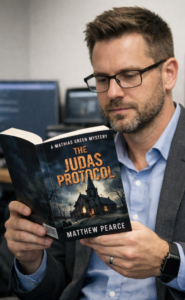
IT professionals live in a world where patterns matter, anomalies deserve attention, and the smallest overlooked detail can become the difference between order and chaos. That is exactly why Mathias Green: The Judas Protocol lands so well for readers in the technology field. This is not a suspense story that depends on cheap shocks or noise. It opens with a theology professor, Silas Hawthorne, found dead inside a locked archive vault, seated upright with no wounds, no struggle, and one hand on an uncatalogued manuscript. From there, Mathias Green uncovers a suppressed Latin text tied to earlier Vatican deaths, along with a chilling idea at the center of the mystery: language that was not written to inspire or persuade, but to instruct and unbind. For anyone who works in systems, security, infrastructure, governance, or digital risk, that premise feels instantly familiar because it is built on hidden logic, access, control, and consequences.
What makes this novel especially effective for an IT audience is that it mirrors the mental environment many technical people already inhabit. Modern technology work is shaped by constant exposure to Reuters cybersecurity coverage, expanding concerns in computer security, and the growing pressure to protect systems that are increasingly complex, distributed, and vulnerable. IT professionals spend their days thinking about what should be trusted, what should be restricted, what may have been hidden in plain sight, and how a single phrase, credential, or overlooked access path can trigger a chain reaction. The Judas Protocol taps into that exact mindset, which is why it feels less like a distant thriller and more like a suspense novel written for people who understand how dangerous invisible structures can be.
A Locked-Room Mystery Built on the Logic IT Professionals Respect
The strongest suspense novels do not simply keep secrets. They create an internal architecture that rewards careful thinking. The Judas Protocol does that from the beginning. The central mystery is not random. It is structured. A dead man in a sealed archive, a manuscript that officially should not exist, historical deaths that echo the present, and a phrase with operational force rather than symbolic meaning all create a framework that feels methodical instead of theatrical. That distinction matters. IT professionals are trained to respect systems that hold together under scrutiny. They look for consistency, traceability, and pattern integrity. This novel gives them all three.
That is one reason the book stands out within the suspense field. Many novels ask the reader to suspend logic in order to enjoy the ride. The Judas Protocol does the opposite. It invites the reader to think harder. It asks the audience to notice sequence, motive, hidden rules, and institutional memory. In technology, this is the same discipline applied to incident response, log analysis, architecture review, or vulnerability triage. The appeal is not only the mystery itself, but the way the mystery unfolds. The story respects readers who understand that what appears supernatural at first glance may actually be procedural, systemic, or deeply embedded.
Its Core Themes Align with the Reality of IT Work
One of the most compelling reasons IT professionals will connect with this novel is the way its themes overlap with the real pressures shaping the tech world. At the center of the book is a suppressed text and an institution that appears to have buried dangerous knowledge for years. That immediately echoes the kind of concerns technical teams face in real life: insider access, undocumented assets, legacy systems, silent dependencies, hidden authority, and the possibility that the biggest threat is already inside the perimeter. Those are not abstract ideas in technology. They are daily realities, and CISA’s Insider Threat Mitigation Guide exists because authorized access can become one of the most serious risks an organization faces. CISA also defines an insider threat as the potential for a trusted person to use authorized access or knowledge to cause harm. That concept is practically woven into the DNA of The Judas Protocol.
The same connection appears in the novel’s atmosphere of controlled access and guarded information. IT professionals do not just think in terms of who has data. They think in terms of who should have data, how that access is authenticated, and what happens when trust is assumed too freely. That is why the book’s institutional secrecy feels so relevant. It resembles the logic behind NIST’s Zero Trust Architecture, which frames security around the idea that no asset or account should receive implicit trust simply because of location or legacy assumptions. In a suspense novel, that principle becomes emotionally powerful. Every archive, record, whisper, and suppressed file becomes charged with the same tension IT professionals already understand from their working lives.
The Novel Understands That Language Itself Can Be a Threat Surface
Perhaps the most fascinating reason this book works for an IT audience is its treatment of language as something operational. The page description makes clear that the phrase at the center of the mystery is not devotional and not merely interpretive. It is instruction. That is a deeply modern idea, especially for people in technology. Code is instruction. Scripts are instruction. Policies are instruction. Prompts are instruction. Authentication flows, automation chains, and permissions models all function through precise language. When language is malformed, manipulated, or weaponized, the results can be catastrophic. The Judas Protocol turns that truth into psychological suspense.
That theme feels especially timely because IT professionals are now operating in an era where the line between language and execution is becoming thinner. Reuters recently reported on Anthropic’s cybersecurity initiative with major technology partners, noting both the push to use advanced AI for defensive security work and survey data showing many executives have already faced AI-driven attacks. In other words, the modern threat landscape increasingly includes systems that act on language and systems that can be influenced through language. That makes the book feel current in a way many thrillers do not. It speaks to the anxiety of command, automation, and unintended consequence without ever needing to turn into a technical manual. The result is a novel that feels intellectually connected to the age of AI, even though its mystery is rooted in archives, manuscripts, and history. Reuters reporting on AI cybersecurity initiatives reinforces just how relevant that tension has become for today’s IT leaders.
It Delivers Psychological Suspense Without Losing Intellectual Weight
Many IT professionals prefer fiction that does more than entertain. They often gravitate toward stories with architecture, moral complexity, and an undercurrent of systems thinking. The Judas Protocol succeeds because it carries psychological suspense and intellectual substance at the same time. The seminary setting gives the story a closed environment full of hierarchy, memory, ritual, and hidden records. The locked-vault death gives it a clean, sharp point of entry. The suppressed manuscript gives it mythic weight. The concealed obsession in faculty records adds human instability. The “second voice” that echoes through the halls creates an atmosphere of uncertainty that feels psychological rather than merely physical. Together, those elements create a novel that rewards analytical readers without becoming cold.
That balance matters. IT professionals spend enough time in technical documentation, ticketing systems, roadmaps, audits, and incident reports. When they read fiction, many want something immersive but not empty. They want tension with intelligence behind it. They want a story that trusts them to follow a layered problem. They want the satisfaction of watching a sharp mind move through ambiguity. Mathias Green appears positioned precisely for that kind of reader. He does not accept anomalies at face value. He follows patterns. He reads beneath surfaces. He challenges the official explanation. Those are the instincts of a strong investigator, but they are also the instincts of a strong technologist.
Its Mood Mirrors the Headlines IT Professionals Already Live With
The reason this novel feels so natural for an IT reader is not only because of its plot, but because of its emotional temperature. The IT world is shaped by persistent low-level dread. Teams monitor alerts, patch vulnerabilities, manage identity, review logs, document risk, and prepare for failures that may never become visible to the public. They understand the quiet pressure of maintaining trust under conditions where compromise is always possible. That same pressure runs through The Judas Protocol. It is not loud. It is accumulating. It is the sense that something has been wrong for a long time, and that the wrongness has been structured, preserved, and protected.
That emotional overlap becomes even sharper in the context of current cybersecurity news. Reuters reported this week that the Justice Department disrupted a Russian military-run DNS hijacking network that targeted thousands of routers worldwide, with officials saying sensitive traffic and information had been captured. IBM’s X-Force Threat Intelligence Index 2026 also highlights AI-accelerated attacks, a year-over-year increase in the exploitation of public-facing applications, and a sharp rise in active ransomware groups. For IT professionals, that means daily work already involves hidden pathways, compromised infrastructure, stolen credentials, and the uneasy reality that trust can be exploited at scale. A novel like The Judas Protocol resonates because it turns that same atmosphere into fiction with depth, tension, and meaning. Reuters coverage of the Justice Department’s disruption of a Russian DNS hijacking network and IBM’s latest threat findings show how naturally the book’s themes connect with the world IT professionals are already navigating.
Why It Stands Above Many Other Choices in the Genre
What separates this book from many other suspense reads is that it does not rely on surface-level twists alone. It appears to understand that the most unsettling fears are often conceptual. Hidden instructions are frightening. Institutional silence is frightening. Knowledge that should not exist is frightening. A pattern of deaths nobody has properly explained is frightening. These are all fears rooted in structure, which is exactly why they land with readers trained to think structurally. IT professionals are often less impressed by spectacle than by inevitability. They respond to stories where the danger feels embedded in the design. That seems to be where The Judas Protocol excels.
It also helps that the book blends old-world mystery with modern relevance. A seminary archive and a suppressed Latin manuscript could easily have felt distant from contemporary readers. Instead, the setup becomes more compelling because it mirrors current concerns in a new shape. The book transforms archives into restricted repositories, hidden manuscripts into undocumented assets, institutional secrecy into access governance, and dangerous language into executable logic. That is not a gimmick. It is why the novel feels especially well matched to readers who work in infrastructure, security, networks, cloud environments, compliance, or enterprise architecture. Thematically, it speaks their language even when the setting is far removed from a server room.
Conclusion
Mathias Green: The Judas Protocol is one of the best psychological suspense novels choices for IT professionals because it meets them where they already live mentally. It offers a locked-room death, a forbidden text, hidden institutional history, and a protagonist who refuses to accept the official story. More importantly, it builds its tension around the same forces that define modern technology work: trust, access, pattern recognition, hidden systems, and the danger of instructions that should never have been followed. That combination gives the novel unusual strength. It is atmospheric without being vague, intelligent without being sterile, and psychologically unsettling without sacrificing narrative drive.
For readers in technology, that makes this novel more than a good thriller. It makes it a deeply satisfying one. It speaks to the analytical mind, the risk-aware mind, and the mind that knows the biggest problems are rarely the obvious ones. In a field shaped by insider risk, zero-trust thinking, AI security concerns, and relentless cyber headlines, a suspense novel built on hidden commands and buried systems feels not only entertaining, but strikingly relevant.