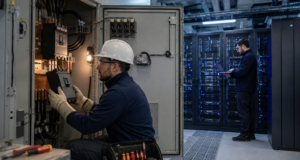
Modern businesses depend on servers, networking equipment, cloud connections, telecommunications systems, security devices, and data storage platforms operating around the clock. These technologies receive most of the attention during IT planning, yet every device ultimately depends on a stable electrical system. A company can invest heavily in advanced hardware and still face a damaging shutdown because an aging circuit breaker, overloaded electrical panel, or poorly coordinated power-distribution system fails at the wrong moment.
Circuit breakers are designed to interrupt electrical current when a circuit experiences an overload, short circuit, or another unsafe condition. In offices, server rooms, industrial facilities, and data centers, these protective devices help prevent equipment damage, overheating, electrical fires, and prolonged outages. Their importance continues to grow as organizations install increasingly power-intensive infrastructure.
The U.S. Department of Energy reports that expanding data-center deployment and artificial intelligence applications are contributing to substantial growth in electricity demand. As computing loads rise, businesses must evaluate the physical infrastructure supporting their digital operations. Circuit breakers replacement should be treated as part of IT resilience planning rather than an isolated facilities-maintenance expense. ⚡
The Electrical Foundation Beneath Modern IT Infrastructure
IT infrastructure includes more than computers and software. It encompasses servers, storage systems, routers, switches, cooling equipment, backup power supplies, communication lines, monitoring platforms, and the electrical equipment that keeps everything operational. The Wikipedia overview of data centers describes facilities built around computer systems and related components, including telecommunications and storage systems. Those systems cannot operate reliably without dependable power distribution.
Electricity enters a facility and moves through service equipment, panels, circuit breakers, wiring, outlets, power distribution units, and connected devices. Each component must be appropriate for the electrical load. A weakness anywhere in that path can affect an entire department, server room, production area, or customer-facing service.
An older breaker may continue operating under normal conditions while becoming unreliable during periods of increased demand. Loose connections, corrosion, heat damage, improper sizing, mechanical wear, and outdated equipment can compromise electrical protection. These conditions may remain unnoticed until equipment is added, workloads increase, or a fault occurs.
Routine inspection provides businesses with an opportunity to find problems before they escalate. Organizations searching for professional equipment options and replacement support can review Circuit Breakers Replacement Near Me as part of the planning and sourcing process. Installation, testing, and modifications to electrical systems should always be handled by qualified electrical professionals in accordance with applicable codes and manufacturer requirements.
Why Circuit Breaker Problems Can Become IT Emergencies
A circuit breaker failure can produce consequences far beyond a temporary loss of electricity. If a breaker trips unexpectedly, servers may shut down before backup procedures are completed. Network switches can lose power, communications can be interrupted, security systems can go offline, and employees can lose access to essential applications.
A sudden shutdown may also affect data integrity. Modern systems are designed to tolerate many disruptions, but abrupt power loss can still contribute to corrupted files, incomplete transactions, failed updates, damaged hardware, and recovery complications. Even when data remains intact, restarting interconnected systems in the correct sequence can take considerable time.
The financial impact can extend across the organization. Employees may be unable to work, customers may lose access to online services, production can stop, and support teams may face a flood of service requests. Contractual obligations and service-level agreements may also be affected.
Research from the Uptime Institute has consistently identified power issues as a major cause of serious and severe data-center outages. Its outage analysis also indicates that many significant incidents could have been prevented through stronger management, processes, and configuration. These findings reinforce a practical point: reliable IT operations require disciplined attention to the physical power systems supporting them.
Warning Signs That Electrical Protection Needs Attention
Circuit breakers do not always fail without warning. Facilities and IT teams may notice recurring trips, buzzing sounds, unusual odors, visible discoloration, excessive heat, flickering lights, unstable equipment performance, or unexplained power interruptions. A panel that feels unusually warm or contains damaged components requires prompt professional attention.
Recurring trips should never be treated as a nuisance to be repeatedly reset without investigation. The breaker may be responding correctly to an overload or fault. It may also be damaged, improperly sized, or incompatible with the panel. Replacing a breaker without determining why it tripped can leave the underlying problem unresolved.
Another warning sign is a widening gap between the building’s original electrical design and its current technology load. Many offices were designed before high-density servers, extensive wireless networks, smart-building controls, charging stations, surveillance systems, and always-connected workstations became common. Equipment may have been added gradually without a complete review of available electrical capacity.
Documentation can reveal additional concerns. Missing circuit directories, unclear panel labels, undocumented modifications, obsolete breaker models, and unavailable replacement parts can complicate maintenance and emergency response. A qualified assessment can identify these issues and establish an accurate record of the facility’s electrical distribution system. 🔌
The Growing Power Demands of Data Centers and AI
Artificial intelligence, high-performance computing, edge processing, and data-intensive business applications are changing electrical requirements. More powerful processors generate additional heat, increasing both computing and cooling loads. The electrical system must support servers as well as the environmental equipment required to keep them within safe operating temperatures.
The Department of Energy’s data-center report found that data centers accounted for approximately 4.4% of total U.S. electricity consumption in 2023 and projected a substantial increase by 2028. This growth places greater pressure on utilities, facility operators, and the electrical equipment inside individual buildings.
The trend affects more than hyperscale data centers. Regional offices, healthcare facilities, manufacturers, retailers, schools, logistics companies, financial firms, and professional-service organizations all operate technology-dependent environments. A modest server room can still support essential payroll, communications, security, customer records, inventory, or production systems.
As workloads expand, circuit-breaker replacement may become part of a broader modernization project involving new panels, dedicated circuits, load balancing, power monitoring, surge protection, uninterruptible power supplies, generators, or automatic transfer equipment. The correct solution depends on the facility, operating requirements, connected equipment, and applicable electrical codes.
Circuit Breakers, UPS Systems, and Backup Generators Must Work Together
A resilient power strategy depends on coordination. Circuit breakers, uninterruptible power supplies, generators, transfer switches, and power distribution equipment cannot be managed as unrelated components. Each element affects how electricity moves through the facility during normal operation and emergency conditions.
A UPS can provide short-term power when utility service is interrupted, allowing equipment to remain online until a generator starts or systems shut down safely. However, a UPS cannot correct every upstream electrical defect. A generator can provide emergency electricity, but it cannot protect infrastructure if breakers, connections, or transfer equipment are deteriorated or incorrectly configured.
The Cybersecurity and Infrastructure Security Agency emphasizes the importance of secure, functioning, and resilient critical infrastructure. That principle applies directly to organizations whose services depend on interconnected digital and physical systems. Electrical protection forms part of the operational foundation that allows cybersecurity controls, communications systems, and recovery tools to remain available.
Coordination studies and professional electrical evaluations can help determine how protective devices will respond under fault conditions. The goal is to isolate the affected circuit while allowing unaffected systems to continue operating whenever the design permits. This approach can reduce the likelihood that one localized electrical problem creates a facility-wide interruption.
Building Circuit Breaker Replacement Into IT Risk Management
Electrical maintenance has traditionally been managed by facilities personnel, while technology risk has been assigned to IT departments. That separation can create blind spots. IT leaders may add equipment without understanding available electrical capacity, while facilities teams may schedule electrical work without knowing which systems are business-critical.
A coordinated planning process allows both teams to identify dependencies. IT personnel can document critical devices, acceptable downtime, shutdown procedures, redundancy requirements, and recovery priorities. Facilities professionals and qualified electricians can evaluate panels, breakers, loads, environmental conditions, equipment age, and maintenance history.
The National Institute of Standards and Technology Cybersecurity Framework helps organizations understand and manage cybersecurity risk. Although circuit-breaker maintenance is primarily an electrical and operational matter, the same risk-management mindset is valuable. Businesses need to identify critical assets, understand potential disruptions, implement safeguards, detect abnormal conditions, respond effectively, and restore operations.
Circuit-breaker records should be included in infrastructure documentation. Useful information includes manufacturer, model, rating, installation date, inspection history, supported circuits, replacement availability, and known deficiencies. Accurate records improve planning and help technicians respond more efficiently during an incident.
Planning Replacement Without Creating Additional Downtime
Replacing circuit breakers in a technology-dependent facility requires careful scheduling. The work may require circuits or panels to be de-energized, creating temporary downtime for connected equipment. A planned interruption is usually far less damaging than an unexpected failure, but preparation remains essential.
IT teams should identify all systems affected by the electrical work and verify that current backups are available. Equipment should be shut down according to manufacturer instructions, and critical applications should be migrated or placed on redundant infrastructure when feasible. Employees and customers may require advance notice if services will be temporarily unavailable.
Qualified electricians should confirm that replacement breakers are approved for the specific panel and application. Physical fit alone does not establish compatibility. Breaker type, voltage, current rating, interrupting capacity, trip characteristics, and manufacturer requirements must be considered.
The National Institute of Standards and Technology has highlighted physical facilities, power, operational technology, supply chains, and security posture as important considerations for AI data centers. This reflects a broader industry reality: digital infrastructure security and physical infrastructure reliability are increasingly interconnected.
Once replacement work is completed, circuits should be accurately labeled and related documentation updated. IT staff should confirm that systems restart correctly, monitoring tools reconnect, alerts function, and backup power equipment remains operational.
Why Preventive Replacement Can Be a Strategic Investment
Circuit-breaker replacement may not attract the attention associated with a new server platform or cybersecurity product, but it can protect every technology investment connected to the electrical system. Preventive work can reduce emergency repair costs, limit unplanned downtime, improve safety, and support future growth.
Reliable electrical protection also strengthens business continuity. Customers expect websites, communications, payment systems, and digital services to remain available. Employees expect uninterrupted access to the tools required to perform their work. Vendors and partners depend on stable connections to shared platforms. A small electrical component can influence all of these relationships.
Strong infrastructure management also demonstrates organizational maturity. It shows that leadership understands the connection between physical equipment, digital operations, safety, and customer service. That perspective is increasingly important as companies adopt automation, artificial intelligence, connected devices, and other power-dependent technologies. 🖥️
Conclusion
Circuit breakers are easy to overlook because they normally operate quietly in the background. Their role becomes visible when a fault, overload, or failure interrupts essential systems. By that point, the organization may already be facing downtime, lost productivity, recovery expenses, damaged equipment, and frustrated customers.
Circuit breakers replacement belongs within a comprehensive IT infrastructure strategy. Businesses should coordinate facilities personnel, IT leaders, risk managers, and qualified electrical professionals to inspect existing equipment, document critical circuits, evaluate increasing loads, and plan replacements before failures occur.
The most effective IT infrastructure is supported by secure software, reliable hardware, tested recovery procedures, and a dependable electrical foundation. Replacing outdated or compromised circuit breakers may appear to be a modest facilities project, but it can be the hidden upgrade that keeps servers running, employees connected, customers served, and a costly shutdown from becoming reality.